

The Hidden Costs of Apps: Calculate Your True Rate
Most massage therapists can tell you what they charge. Far fewer can tell you what they actually earn per working hour, and that gap is where a lot of income quietly disappears.
It is an easy thing to miss. A booking lands, a number appears on your screen, and that number feels like the truth. It rarely is. Between the moment a client books and the moment money clears into your account, several things happen that shrink the figure. Some are obvious. Some are so normal that most therapists have stopped counting them at all.
This is not an argument against working through platforms. Platforms bring you clients you would struggle to reach alone, and they handle the parts of the job most therapists dislike. The point is simply that you should know your real number before you decide whether a rate is good. Once you know it, every decision about which work to accept gets easier.
The number on the screen is not the number in your pocket
Start with a simple exercise. Take one recent working day. Write down the total you were paid across every booking. Then write down the total time that day consumed, from the moment you left home to the moment you got back.
Most therapists find the second number is considerably larger than they expected. A sixty minute treatment is almost never a sixty minute commitment. There is travel there, travel back, setup, breakdown, a conversation with the client before and after, and the gap between bookings that is too short to be useful but too long to ignore. In a city like London, where a three mile journey can take forty minutes, that arithmetic gets punishing quickly.
Divide the money by the total time and you have your true hourly rate. It is often a sobering figure, and it is the only one worth using when you compare opportunities.
What actually comes out of the headline figure
When you are working out the real cost of any platform or private arrangement, these are the deductions worth listing on paper:
- Commission or service fees taken from each completed booking
- Travel time and transport costs, including fuel, congestion charges, parking, or fares
- Equipment and consumables, such as oils, couch roll, towels, laundry, and replacing a table that wears out
- Unpaid admin, including messaging clients, confirming times, and chasing payment
- Insurance, professional membership and continuing education
- Lost income from late cancellations or clients who are not there when you arrive
- Tax and national insurance, which many therapists calculate too late in the year
Not all of these apply to every situation, and some are simply the cost of being self employed. But they belong in the calculation. A rate that looks strong before deductions can look very ordinary afterwards, and a rate that looks modest can hold up well if the platform absorbs some of these costs on your behalf.
Convenience without lowering the standard
The other lesson that years of operating across London boroughs has reinforced is that convenience and quality are not actually in tension, even though most services in this space treat them as if they are. Customers want the ease of booking from their phone, paying securely in advance, and having a therapist arrive at their door. But they also want that therapist to be properly qualified, the equipment to be professional grade, and the whole experience to feel considered rather than rushed.
This is part of why the booking journey itself has been built the way it has. Customers can browse therapist profiles, read bios and reviews, and choose someone whose experience matches what they need, whether that is prenatal care, a Thai Oil Massage, or targeted Sports Massage after a heavy training block. Booking as a guest through the website works well for a first time visit, but the app has become the natural home for anyone who books regularly, since it unlocks faster rebooking, stored details, and direct messaging with a therapist ahead of a session.
A few things stand out consistently when we look back at what has worked:
- Clients return more often once they find a therapist whose style suits them, which is part of why browsable profiles matter so much
- Prepaid, card only booking removes the awkwardness of exchanging money in person and keeps the whole process feeling professional
- The 24 hour cancellation window has proven fair in practice, giving people flexibility without undermining therapists’ schedules
- Zen Points has quietly become a meaningful part of the experience for regular customers, turning ordinary bookings into small ongoing savings
Why a fixed £58.50 changes the maths
At Zen Hut, a sixty minute treatment is £78 to the client and £58.50 to the therapist. That is a fixed seventy five percent payout, and the word fixed is doing a lot of work in that sentence.
Fixed means you can plan. You know before you accept a booking exactly what will land in your account, which means you can build a week around a target rather than hoping the numbers work out. If you need to earn a certain amount by Friday, you can count backwards and know precisely how many treatments that takes. That sounds like a small thing. In practice it is the difference between running a business and reacting to one.
It also means the calculation above becomes genuinely useful. If you know your payout is £58.50 and you know a particular booking involves fifty minutes of travel each way, you can decide whether that booking is worth taking. If a cluster of bookings sits within the same postcode, you can see immediately how much better that day performs. Therapists who work this way tend to build tighter, more profitable schedules within a few months, simply because they can see what is working.
Longer treatments follow the same structure. A ninety minute treatment is £102 and a one hundred and twenty minute treatment is £140, with the same seventy five percent split applied. Longer bookings almost always produce a stronger true hourly rate, because the travel and setup time is spread across more paid minutes. That is worth knowing when you are deciding which durations to make available.
Predictability is a form of pay
There is a second kind of hidden cost that never appears on an invoice, and that is uncertainty.
When you do not know what a booking will pay until after it completes, you carry a low level of mental load through every working day. You take bookings you are not sure about. You accept awkward travel because you cannot tell whether refusing it will hurt you later. You end the month unable to explain to yourself why one week earned so much less than another.
A clear, published split removes that. You are not guessing at a formula or watching your effective rate drift. Zen Hut bookings are prepaid online by card, so the money for a treatment is already collected before you arrive, and the twenty four hour cancellation window means late changes are handled under a stated policy rather than left to negotiation. None of this makes the work easier physically, but it does make the business side of it far quieter, and quiet is worth something when you are treating six people a day.
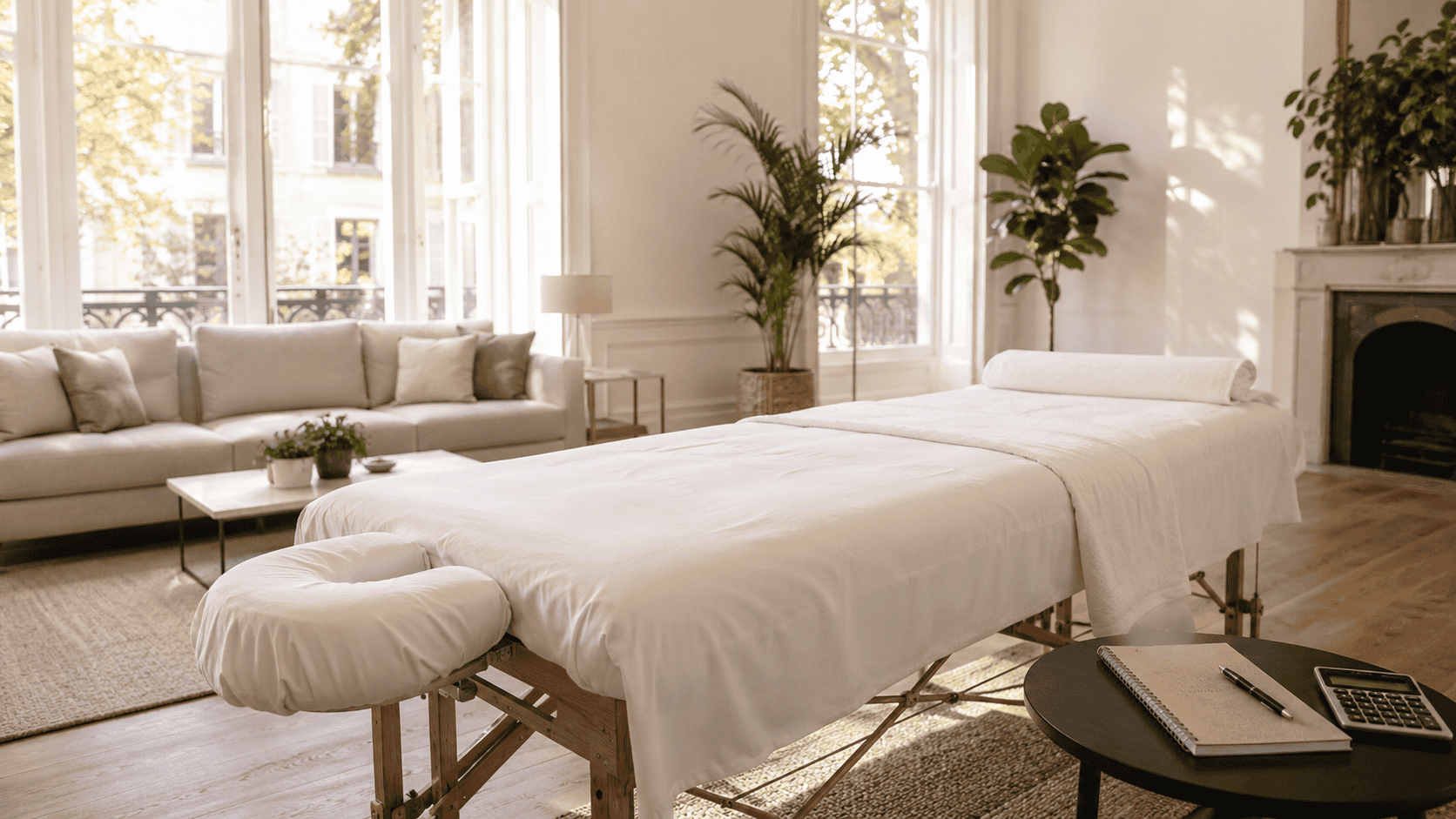
The professional treatment table matters here too, and not only for the client. Working at proper table height protects your body over a long career. Treatments delivered on a sofa or a floor mattress cost you in posture, and that cost lands years later in your shoulders and lower back. A setup that lets you work correctly is part of your real rate, even though nobody puts it on a payslip.
What to do with your number once you have it
Once you have your true hourly rate, use it as a filter rather than a judgement. It is not there to make you feel bad about your last quarter. It is there to tell you which kinds of work deserve more of your week.
Look at which areas produce the best rate for you. Look at whether longer treatments outperform shorter ones once travel is included. Look at how repeat clients change the picture, since a client who rebooks costs you nothing to acquire and often lives conveniently close to someone else you already see. Then shape your availability around what the numbers actually say.
Most therapists who go through this exercise do not dramatically change what they do. They simply do more of the profitable part and less of the rest, and their income rises without their hours increasing. That is the whole point of knowing your real rate.
Frequently Asked Questions
Therapists receive seventy five percent of the treatment price. A sixty minute treatment pays £58.50 to the therapist, a ninety minute treatment pays seventy five percent of £102, and a one hundred and twenty minute treatment pays seventy five percent of £140.
The split is fixed and published, so you know what a booking pays before you accept it.
Zen Hut is a table based service, so treatments are delivered on a professional treatment table rather than on a floor setup or a client's own furniture.
All Zen Hut bookings are prepaid online by card. Clients pay at the point of booking rather than in person.
Zen Hut operates a twenty four hour cancellation window. Late cancellations are usually non refundable, though discretion can apply depending on the circumstances.
Add up everything you were paid across a working day, then divide it by the total time that day took you, including travel, setup and breakdown. That figure is far more useful than your headline treatment price.